Solar and Electric Attic Fans Minnesota

High-performance attic ventilation solutions designed to purge extreme summer heat, control winter moisture, and optimize energy efficiency for Minnesota homes.

Quick Answer: Attic fans in Minnesota active ventilation systems reduce summer attic heat accumulation and purge moisture build-up before it damages structural framing or degrades ceiling insulation. By exchanging superheated attic air with cooler outdoor air, solar and electric attic fans lower attic temperatures by up to 50 degrees Fahrenheit during peak summer months. When paired with adequate soffit intake vents and proper ceiling air sealing, attic ventilation fans optimize HVAC efficiency, prevent roof deck moisture condensation, and extend shingle life across Minnesota homes.

High-Performance Ventilation

Keep Your Minnesota Attic Cool, Dry, and Balanced

A balanced attic ventilation system is one of the most critical structural components of a resilient home. During hot Minnesota summers, solar radiation converts asphalt roof shingles into intense thermal radiators, raising unventilated attic space temperatures above 150 degrees Fahrenheit. This intense heat radiates downward into living spaces, forcing air conditioning units to run continuously and driving up monthly electricity expenses.

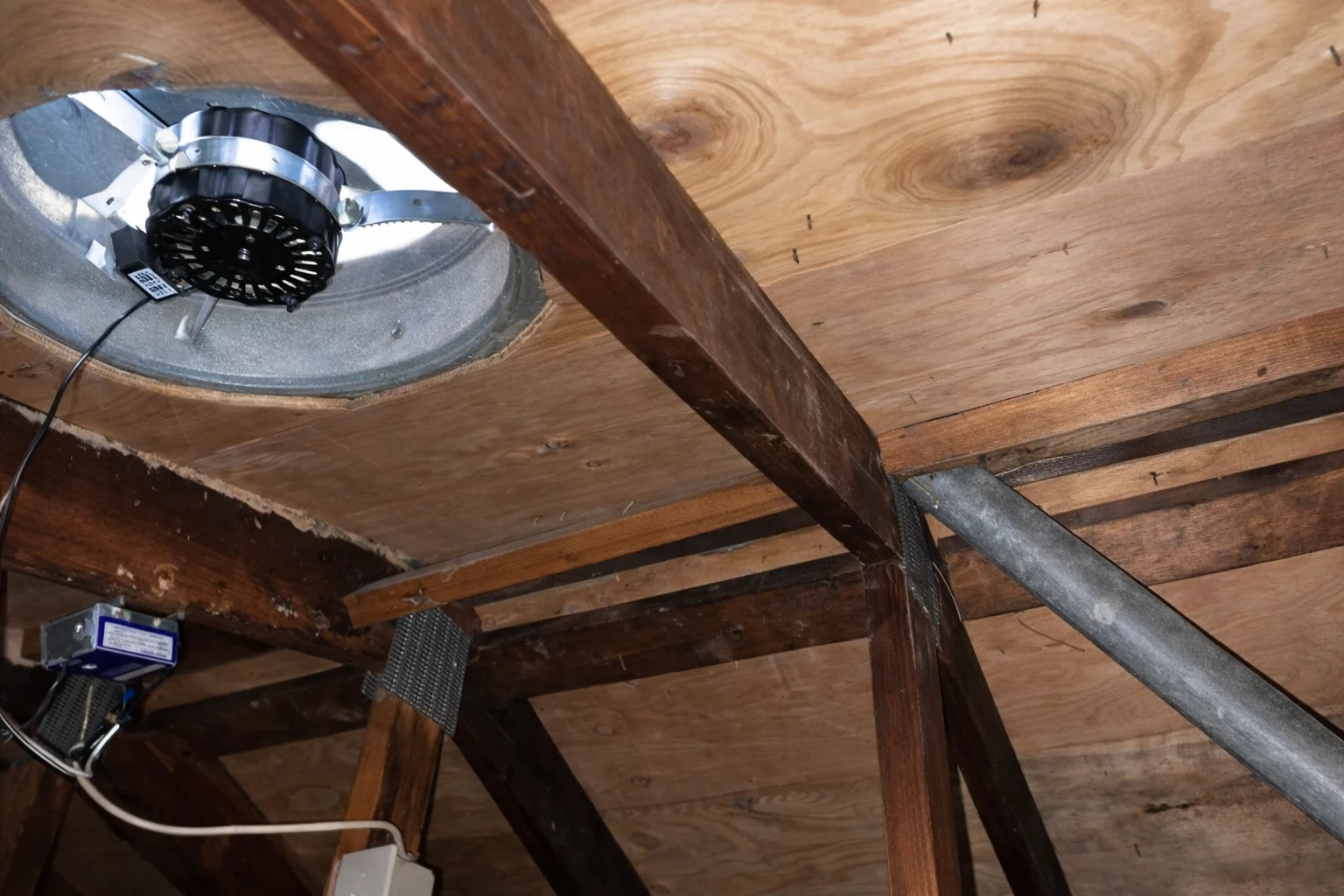
Installing high-efficiency solar and electric attic ventilation fans creates continuous mechanical air exchange. Active fan ventilation pulls cool air through soffit eave vents while expelling trapped superheated air through roof cap mounts. Beyond summer heat reduction, attic ventilation maintains relative humidity balance, preventing structural moisture damage to roof decking, rafters, and joists.

According to comprehensive cooling research from the U.S. Department of Energy Cooling Fan Guidelines, powered and solar ventilation systems significantly reduce whole-house cooling loads when integrated with adequate net free intake vent area. Further research on building envelope protection from the U.S. Department of Energy Moisture Control Standards emphasizes that removing moisture vapor before it reaches its dew point prevents fungal growth and insulation degradation.

Attic Ventilation Fans Minnesota installation showing proper soffit intake and roof fan exhaust
Continuous Thermal Purge

How Powered Attic Ventilation Works

Attic fans rely on fundamental thermodynamics: establishing positive air displacement at the roof ridge to draw low-level intake air through soffit vents. Observe the interactive airflow visualization below demonstrating continuous thermal release.

Continuous Attic Airflow & Thermal Purge Mechanism
Visualizing intake airflow through soffit baffles and active heat exhaust through the roof fan.
Ceiling Insulation Layer (R-60) Soffit Intake Soffit Intake Attic Fan Exhaust Purging 150°F Attic Heat
System Selection

Solar Attic Fans vs. Electric Hardwired Attic Fans

Selecting between solar attic fans and electric powered fans requires evaluating attic square footage, roof exposure, and existing electrical wiring. Both technologies deliver substantial thermal displacement, but their operational parameters differ significantly.

Solar Powered Attic Fans

Solar attic fans utilize integrated photovoltaic panels to drive brushless DC motors. They operate entirely off-grid without electrical consumption, automatically ramping up blade rotation speed during peak midday solar exposure when attic temperatures reach maximum levels. Solar units require zero hardwiring, making installation straightforward and cost-effective across Minnesota homes.

Electric Powered Attic Fans

Hardwired electric attic fans draw power directly from the home's 120V electrical panel. Controlled by precision adjustable thermostats and humidistats, electric fans deliver constant volumetric airflow regardless of cloud cover or roof orientation. They are ideal for large attics exceeding 2,500 square feet or complex rooflines with shaded exposures.

Feature / Parameter Solar Attic Fans Electric Hardwired Fans Passive Ridge & Soffit Vents
Power Source Direct Photovoltaic Solar Panel 120V Household Electric Line Zero (Passive Convection)
Operating Electricity Cost $0.00 / year $15 to $35 / year $0.00 / year
Airflow Capacity (CFM) 800 to 1,800 CFM 1,000 to 2,500 CFM Variable (Wind Dependent)
Thermostat & Humidistat Included on Advanced Models Standard Dual Control Included N/A (Always Passive)
Cloudy Weather Performance Reduced Airflow Speed Full Rated Performance Unchanged
Electrical Wiring Requirement None Required Dedicated Electrical Circuit None Required
Recommended Attic Size Up to 2,200 sq. ft. Up to 3,500+ sq. ft. Requires Continuous Ridge Length
Empirical Performance

Peak Summer Attic Temperature Reduction

Field data from thermal testing demonstrates how active attic ventilation suppresses internal roof space temperatures during extreme 95°F summer heat conditions in Minnesota.

Peak Attic Temperature Comparison (°F External = 95°F)
Evaluating internal attic temperatures across four ventilation setups during peak summer afternoon heat.
Unventilated Attic Passive Vents Only Solar Attic Fan Electric Powered Fan 152°F 128°F 104°F 96°F 80°F Outdoor Baseline 160°F Peak Threshold
Interactive Sizing Tool

Attic Fan Airflow & Ventilation Calculator

Use our interactive sizing tool below to calculate your home's required cubic feet per minute (CFM) airflow, recommended intake vent net free area, and projected cooling cost impact.

Attic Fan Sizing & Intake Estimator
Minimum Recommended Fan Airflow
1,208 CFM
Required Soffit Intake Area (Net Free Area)
580 Sq. In.
Estimated Summer AC Cost Reduction
$180 / Season
*Calculations based on 0.7 CFM baseline per square foot multiplied by pitch factor. Intake vent area sized at 1 sq. ft. NFA per 300 CFM exhaust capacity.
Building Science Insights

The Science of Attic Ventilation, Winter Moisture, and Ice Dams

Minnesota winters create severe thermal stresses on residential roof assemblies. Warm, moisture-laden interior air naturally rises toward the attic space through ceiling bypasses around light fixtures, attic hatches, and wall top plates. When this humid air encounters sub-freezing roof decking, water vapor condenses into frost and ice accumulation.

Building science research from the University of Minnesota Extension Ice Dam Prevention Guide demonstrates that ice dams form when warm air leaking into the attic melts roof snow cover. The meltwater flows down the roof pitch until reaching cold overhang eaves, where it refreezes into solid ice barriers. As ice builds, trapped meltwater backs up beneath shingle laps, saturating roof sheathing, wall cavity insulation, and interior drywall.

It is vital to understand that powered attic fans are not a standalone solution for ice dams. If installed without complete ceiling air sealing, a high-capacity exhaust fan can create negative pressure inside the attic, pulling warm air directly out of living spaces and worsening heat loss. Professional attic retrofits require combining balanced ventilation with thorough Attic Air Sealing and high-R-value Attic Insulation.

Furthermore, technical reports from the USDA Forest Products Laboratory and thermal testing at the Oak Ridge National Laboratory Building Envelope Division confirm that maintaining cold roof decking via uniform intake airflow protects wood framing against long-term moisture decay and fungal decay spores.

Professional Protocol

Our Step-by-Step Attic Fan Installation Process

Crescent Moon Insulation executes precise installation protocols to ensure watertight roof integration, balanced intake airflow, and optimal thermal performance.

01

Thermal & Intake Audit

We evaluate attic square footage, roof pitch, existing soffit net free intake area, and ceiling air bypass leakage.

02

Airflow Balancing

We calculate precise CFM ventilation requirements and clear blocked soffit baffles to prevent negative pressure.

03

Roof Mount & Flashing

We cut exact roof penetrations, insert heavy-duty commercial flashing, and seal shingle overlaps with weatherproofing sealant.

04

Calibration & Testing

We calibrate dual thermostat/humidistat controls, verify fan blade rotation, and audit directional airflow balance.

Expert Answers

Attic Fans Minnesota FAQs

Explore answers to common questions about attic fan installation, solar performance, and ventilation balancing in Minnesota homes.

How big of an attic fan do I need for my home in Minnesota?

Attic fan capacity is measured in Cubic Feet per Minute (CFM). The baseline industry standard requires 0.7 CFM per square foot of attic floor space, plus a 15 percent increase for steep roof pitches or dark shingle colors. For example, a 1,500 square foot attic requires a fan rated for at least 1,200 to 1,400 CFM.

Are solar attic fans effective during Minnesota winters?

Yes, solar attic fans continue operating whenever sunlight strikes the solar panel. In winter, they assist passive vents by purging excess moisture vapor carried up from the home before it condenses on cold roof decking.

Should an electric attic fan run continuously or on a thermostat?

Electric attic fans should always be controlled by a dual thermostat and humidistat control unit. Setting the thermostat between 100°F and 110°F ensures the fan runs only when attic heat peaks, while the humidistat activates exhaust when attic relative humidity exceeds 60 percent.

Can an attic fan pull conditioned air out of my home?

If an attic lacks adequate soffit intake vents or has unsealed ceiling air leaks, a powerful powered fan can depressurize the attic space and pull air from your living areas. Comprehensive air sealing combined with proper intake sizing prevents this issue.

How does an attic fan complement radiant barrier insulation?

Attic fans purge hot air from the attic space, while Radiant Barrier Insulation reflects radiant solar heat away from ceiling insulation. Combining active fan exhaust with radiant barriers creates an unbeatable dual thermal shield during summer heat waves.

Complete Home Performance & Insulation Services

Maximize whole-home energy efficiency by pairing attic ventilation with comprehensive thermal retrofits.

Ready to Improve Your Attic Ventilation?

Contact Crescent Moon Insulation to get a professional assessment and proper ventilation solution for your Minnesota home.